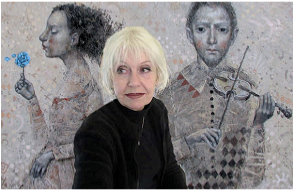
Ritva Voutila was born in Nokia, Finland.

After finishing high school in Nokia she moved to Helsinki to study art at the University of Art and Design. In 1968 she moved to Australia, and then to Spain in 1971, where she continued perfecting her drawing and painting skills for the next ten years while working in fields as varied as garden design and computer programming and analysis. In 1981 she moved back to Australia, settling down in Sydney.

For the next couple of years she worked as a computer sales representative, but in 1983 she became a full time freelance artist working initially in jewellery design, graphic design and advertising.

Her first children's book, 101 Excuses for Not Doing Homework by Carly Little (Scholastic), appeared in 1990 and it became a great success, having been reprinted several times, and is still in print. Many other books followed. See Booklist.

In Sydney, she studied art at Paddington Art School and the Julian Ashton School of Arts. She also holds a BA in Philosophy from Macquarie University, Sydney, and studied Urban Design at Sydney University. She has a special interest in Philosophy for Children.

Ritva is also an accomplished school performer and holds frequent art workshops. Since 1995 she has toured her school programmes throughout Australia to annual audiences of over 20,000 students. 

Twice (1999 and 2005) her show has won a
Frater Award for Excellence in School performances from the NSW State Department of Education and Training.

She now lives in the Blue Mountains, 100 km west of Sydney, with her husband Richard.
Artist's Statement
Bio
Biography
Artist's Statement

I grew up in a house filled with the sound of my fathers violin-Sibelius was his greatest hero. The worlds and feelings evoked in me by this music, and the Nordic tales and legends I loved to read as a child, are now seeping onto my canvases, modified and transformed by many other influences on my life.

My artistic mission is to force open the small cracks on the wall that separate the obvious here-and-now from the elusive and haunting world of dreams and fragmented memories. I want to capture the thrill and trepidation that accompany the adventure to the unknown, to those magic lands, which in many ways are like the world we know, yet in some ways paradoxical or enigmatic enough to cause puzzlement, wonder, and an urge to continue exploring.

Since every picture I paint is an invitation to visit the world it depicts, I attempt to avoid the picture plane becoming a barrier. Rather, I try to make it a door through which one can step in and, once inside, freely roam around and behind the objects depicted. To achieve this I find no better tool than the flexibility of oils to allow the full modelling of the subjects.

I create parallel worlds rather than worlds of fantasy, though I delight in adding symbolic and surrealistic elements to construct visual metaphors and even visual puns.

My worlds are always populated by people (or sometimes by people in animal form) and, where there are people, there are human follies and foibles. These are the subject matter of my work: the human condition with its follies and foibles, the apparent irrationality of human behaviour, and the transient existence of human life. Apart from direct observation of life itself, there are few better sources to provide me with the necessary inspiration than popular sayings, aphorisms, and proverbs.


Sometimes the inspiration comes to me by a random choice of a small number of seemingly disparate ideas, and through a process of pondering on possible connections between those ideas. Although I begin my work with a clear idea pencilled in detail in a preliminary sketch, I make many changes as the work progresses. After I reach the point when the picture begins a life of its own, it is the picture, not I, that suggests the changes or additions. Sometimes I may end up with a subject which is entirely different from my initial idea, which is not so surprising since I often spend several weeks in front of an easel, painting and thinking about what I paint.

There are often components in my work which seem incongruous or out of place. However, there is nothing accidental about them. They are there because of the symbolic associations they evoke, and also because of the weight they add to the composition by their colour or form,
-or both.

No painting, of course, has one single meaning, or creates one single effect on the viewer. Paintings are living things. Like people, they can have 'mood swings' as one mixes his or her own current frame of mind and ongoing life experiences with the interpretation of the painting.
_______________________________________________________________________
HOME  : :  BIOGRAPHY  : : BOOKLIST : :  PORTFOLIO  : :  SCHOOL VISITS : :  CONTACT